It’s 6am on a Monday morning in mid-September. In truth it doesn’t matter which month, which day, or the exact time of the morning. What matters is that it is, in fact, morning, and I am, in fact, awake. In the groggy, half stumbling, half lit moments after waking up but before sweatpants and a tee, I make my bed. The first in a line of things I have to do each morning. The first of many habits I have taught myself over the years.
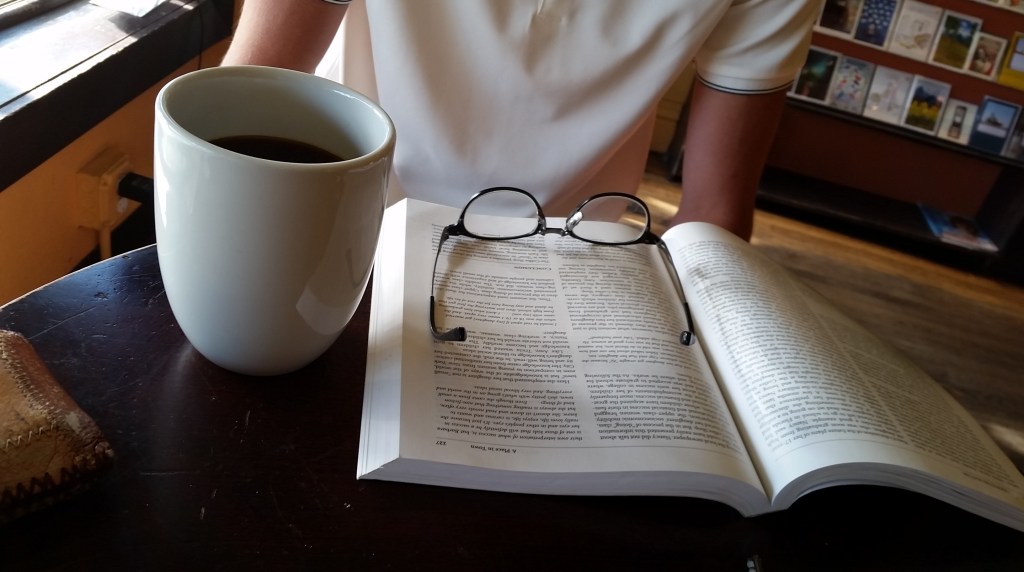
With my bed made and sweatpants donned and with more clarity entering the mind and eyes, I can embark on the next of the habits: coffee. With mug in hand I grab a book and open the curtains, I sit in my chair and read for thirty or forty-five minutes before a quick bathroom break and assembling my lunch and bag for work, putting on work clothes, and leaving for the day.
The fact remains that without these steps, without these habits, I would be lost at 6am on a Monday morning in mid-September. Lost physically, lost mentally, lost to the day already. The fact remains that we need rituals.
I have three rituals in the mornings: making my bed, making coffee, and reading.
The first of these is the oldest and most constant. The only truly non-negotiable and unchanging of my morning.
It goes back to my freshman year of college when I attended, for one semester, Franklin University Switzerland in Lugano, Ticino, Switzerland. More glamorous than it sounds, I assure you. Picture overpriced everything, long walks downhill to the grocery store and longer walks uphill with full bags of hot dogs, butter, and noodles. It was pretty, I will concede that, but I had no intention of studying foreign affairs or international business relations and found myself floundering within a couple of months. Perhaps the floundering had more to do with an unpreparedness for the post-high school real world than FUS, but that’s another thought entirely.
I fortunately didn’t live in a true freshman-style dorm room that semester and instead shared a one-bedroom apartment with a boy named Robby whom I had met some eight months earlier at the open house for admitted students. He had asked at the end of that weekend if I maybe wanted to become his roommate to “save the trouble of a randomly assigned one.” I told him that maybe, perhaps, that would be alright. A bit before having to make the decision I sent him message on Facebook (yes, I know, but times were different and we was from Pennsylvania), asking for some clarification.
The series of questions I asked were, I thought and do in fact still think, totally acceptable. They were along the lines of: I go to bed early and wake up early, when do you like to go to bed and wake up? I don’t really like to party or drink very much, do you? I’m a generally clean person who doesn’t like much mess or untidiness, do you keep a clean place?
Every answer he gave eased my concerns. Little did I know.
We signed the papers, which looking back was too much like signing a lease, and moved in together eight months later on our very first day in Europe. That week should have tipped me off, I think, because his clothes suitcase sat messy and still mostly packed for days before finally, mercifully, put everything away in the shared closet neared my bed than his. That kicked off a series of laundry days where he would pile a mix of clean and dirty clothes indiscriminately into a plastic Ikea bag and do laundry in the basement without setting an alarm (astonishing) for when his clothes would be ready to switch.
Eventually he would remember his clothes and grab the Ikea bag, head down the stairs to retrieve the clean clothes and dump them on his bed, where they would stay for another week as he slept around, over, and through them. He would pick out socks, underwear, shirts (once even a leather belt that had somehow made it through the entire laundry cycle unscathed) and then, at the end of the day, toss them back in the pile on his bed and sleep around them again.
When enough time had elapsed, though it was never clear to me what the system was, he would pile everything into the Ikea bag and start the process over.
I watched this in horror for five months, sometimes self-conscious as I hung up my shirts and stuffed my unpaired socks into their drawer. (I have since matured enough to pair my socks together before stuffing them in the sock drawer and am ashamed to admit that I ever did otherwise.)
That’s one piece of the puzzling nature of Robby. Other pieces include: used towels on the bedroom floor that he would pick up and use again a day later, though he always kept those on his side of the room; extended showers, with music, at seemingly every time I desperately needed to poop; crushed dry noodles on the kitchen floor from dropping and then stepping on rigatoni he serially overcooked to mush and doused in cold, store-bought red sauce; and an unfailing ability to complain about everything from warm sunny weather to an A-minus on a notoriously difficult assignment from a notoriously difficult international affairs professor.
One day each week I had an Italian class in the morning and nothing else the rest of the day and Robby had class all afternoon and into the evening. I treasured these days for the hours I could be certain of no disturbances as I swept, tidied, and picked up rigatoni from under the stove.
On one of those days I returned from Italian and stood in the doorway to our apartment and thought this has gone on far too long. I walked into the bedroom to see a pile of clothes, a wet towel smelling faintly of mildew, abandoned socks, and, somehow, more rigatoni. I saw my own, unmade bed and realized that I could still take back some semblance of cleanliness.
I made my bed then and there.
Nearly ten years later I still, without fail, make my bed as soon as I wake up. It’s a ritual that says “take control, you’ve already managed something today.”
I graduated from Colorado College in Colorado Springs, Colorado four years after moving into a tiny, one-bedroom apartment with Robby. By that time, he had become a distant memory and I lived two years in an objectively dirtier, ramshackle house with two roommates who, though they tried their best, didn’t make their beds every day. The difference, then, must have been that I had my own bedroom and didn’t have to see their messes.
After graduation, I moved with one of those roommates up to Denver to pursue a career in specialty coffee that was infinitely more useful after I left it than while I was doing it.
I started at a brand spanking new coffee shop that advertised itself as a specialty coffee shop run by actual Ethiopian immigrants with a family farm still in operation in Ethiopia. They claimed to be a counter-Starbucks with higher quality beans and better brewing methods.
The only truth being that they were, in fact, Ethiopian immigrants with an operational farm run by distant cousins. The menu was identical to Starbucks, but with only one bean and one roast and without any sort of brewing standard.
But they paid well enough for me to pay my share of rent in a three bedroom house crammed with four people managing an AirBnB in the renovated garage in exchange for discounted rent. (That situation fell apart in no small part to Covid but not entirely because of it.)
I walked into the owner’s office to give my two week notice, which was mightily difficult because the owner could not understand that I, an aspiring specialty barista, was willing to take a pay cut (however it would be a substantial raise when tips were calculated) to work at a different coffee shop that, to her, was no different and no better than hers. I told her that her shop was just like Starbucks right down to the blended ice drinks, which I found out later she took immediate and huge offense to. Three days later she told me there was no need for me to finish out my two weeks.
The other coffee shop that hired me did so not because of my two-month experience, but because of my passion and intense desire to learn coffee. Corvus Coffee is still around and doing well in the Denver coffee scene, but at the time was still a bit of a start-up.
I have a sneaking suspicion that I only got the job because of my in-person interview where I shared the story of how I fell in love with coffee while on a trip to Guatemala in high school without realizing that the manager interviewing me was from Guatemala.
Three months later I was allowed my first bar shift.
It took me three months of training before I was allowed to make my first drink for a customer. I pulled hundred of espresso shots under the watchful eye of the barista trainer who would say things like “taste this shot and tell my why it isn’t good.” I did tastings and was asked to differentiate between coffees based on acids and extractions. I had to figure out whether an espresso was over or under extracted based on two sips. I had to taste distilled water mixed with two drops of different acids and know which acid was which. I learned how to froth milk with a blindfold and know by sound and touch when it was the perfect consistency for lattes, cortados, and cappuccinos (which are all slightly different, mind you). I had to do that because I would have to froth milk while preparing another espresso and talking to other baristas about the next orders during a morning rush. I had to learn the frothing differences between oat, nut, and dairy milks. They are subtle but important. I had to learn and practice customer service that started “as soon as the customer thinks about coming to Corvus.”
But you know what? I fucking loved it.
Had there been a path for me to make $60k per year doing nothing but barista-ing I would retire happier than almost anyone. But Denver, the pandemic, and four people crowded into a three bedroom house had other ideas.
What remains from my time as a specialty barista is two things: an unending judgment of every cortado I drink, and the ritual of making coffee.
Coffee doesn’t have to be special, but it must fit a role. I’m more than happy to drink $0.99 gas station coffee, and in fact prefer it on road trips because of convenience and price. I buy the cheapest grocery store coffee for the same reason and actually stopped grinding my own beans for a while to save time in the mornings.
Coffee doesn’t need to be fancy, but it must take time. I will never again sit around the house while an automatic coffee machine brews up a pot. I need the tactile sensations of weighing, pouring, watching, and stirring. I need the process because it fills a space in my mornings now, the last reminder of a time in my life where I desperately desired craft. The leftover remains of a career that might have been if only for a series of events and unplanned changes.
So, on mid-September Monday mornings just after 6am I stand in the kitchen with 15 grams of grocery store coffee weighed out into my AeroPress listening for the water to boil and then waiting for it to cool just a little bit before weighing the water as I pour it over the grounds. The smell fills my up from toenail to hair-tips and I stand up a little straighter and a little more awake before taking a sip. I stir the coffee and wait until the timer on my phone reads the correct second before I flip and plunge my drink into my favorite decanter and then into my mug that my roommates know not to touch.
Only when the AeroPress, decanter, and used grounds are clean can I move on with my morning.
It’s a ritual that says, “Here’s a memory of your past brought into the present.”
In college I studied English – Creative Writing and wrote an entire, albeit terrible, novel as my senior thesis. I received an A on my thesis for the dedication and hard work I did on the project rather than the quality of the writing. I was young and hadn’t yet accepted that I was a much better non-fiction essayist than I was a fiction writer.
The important bit about my degree, however, wasn’t in the writing itself but in the reading I did for the English Literature side of the degree. I took classes in American Literature, Black Women Writers, Historical Fiction, and Shakespeare. I read widely within the scope of Anglo-Saxon-centric writing and ventured only slightly away from the form of short story and novel. I developed ideas on what good writing should be and felt conflicted that my favorite writers were white males, despite the fact that I am a white male and therefore maybe my identifying with other white males was not only expected but encouraged. But perhaps I only liked them because the course designs meant I read them more than anyone else.
As I got towards the end of my degree and closer to the prospect of moving to Denver to pursue that classic English-major career, I started to wonder how I might continue my study of literature and writing.
My thesis adviser and academic mentor Stephen Hayward sat me down one afternoon to go over final edits of my novel and chat about my future. He was a Canadian novelist and Shakespeare enthusiast who taught creative writing and occasionally a class on Shakespeare to freshmen as a general requirement fulfilling credit. The slight nature of his height, the round glasses, Canadian accent and the invariably spiked gray hair combined with his easy, bright, and loud chuckle gave him a buoyancy that spilled over from the classroom to personal meetings like the one he dragged me into at the end of my academic career.
“What do you like to read?”
“Fitzgerald is my favorite.”
“But what do you read for fun?” He stressed. “For example,” he continued, “When I graduated and started to go to dinner parties with friends who weren’t English majors, I realized that although I could talk for literal hours about Shakespeare, no one else wanted to. After I graduated, I realized I could read literally anything I wanted. Anything at all. No one was telling me what I had to read anymore. And do you know what I did?”
“No clue,” I said, bewildered by the apparent degradation of the reading habits Stephen had instilled in me for three and a half years.
“I started reading baseball essays.” His eyes bored into mine with a necessity for me to understand something.
I couldn’t for the life of me in that office crammed full of volume upon volume of Shakespeare criticism and Canadian literature understand what he wanted me to understand. “That’s interesting,” I said.
“You can read anything you want to now. What are you going to read?” He pleaded with me.
“I have no idea.”
He sighed and picked up the latest iteration of my novel printed on huge paper with incredible margins filled with his notes, “I bet you’ll find something.”
I left his office confused and burdened by the unstapled manuscript that didn’t fit in any folder or backpack I owned. I thought about little Stephen Hayward running around a dinner party asking anyone if they wanted to talk about King Lear only to realize he was surrounded by many fans of Roger Angell.
For the two weeks after that I thought intermittently about what Stephen had said: You can anything you want to now. I still had no clue what I wanted to read.
It’s been almost five years since that conversation. And around New Year’s Day 2023 I picked up a book that had been gifted to me for Christmas because I lived in a studio apartment on my own and was discovering that I hated it.
Fast forward eleven months and I’m seventeen books and countless essays into my reading list and have a new ritual to go along with the coffee and made bed.
I take my coffee, grab whichever book it is I’m reading, and sit for thirty minutes to an hour. When I started doing this it was a choice. I forced myself to sit down and read a little bit each morning. Some days I struggled, thought myself not awake enough to read anything. Some days I struggled because I wasn’t interested in the part of the book I was reading. Some days I didn’t struggle and instead looked forward to the mornings for the reading as much as for the coffee. Eventually those days I looked forward to reading won out and, months after that happened, I find myself getting stressed if I near the end of a book without a new one on the nightstand.
Since this ritual, I’ve read literature, non-fiction, accidentally one smut novel, and hundreds of essays. And it all reminds me that Stephen Hayward was right: I can read anything I want.
On Monday mornings in mid-September around 6:30am, I sit in my chair with the sun starting to cast beams on my made bed with coffee in one hand and a book in the other. It’s three rituals rolled into the Morning Ritual in which my roommates know not to talk to me, not to look at me, not to even say good morning. It’s sacred. It’s necessary. Without these rituals I am cast into an ocean without a sail, a forest without a trail, a mountain without a guide.
Each one reminds me of a past that I no longer live. But each one also informs the present in which I exist. And each one acts as foundation for the future I aim to build. I turned twenty-six almost exactly twelve months ago and picked up a reading habit to go along with making my bed and making my coffee. I turn twenty-seven in a week’s time and wonder now what new ritual comes with this new age, and which past it will remind me of in the years to come.
But I know one thing: we need these rituals that we build because without them, we are simply shells.
 Craig Carey
Leave a comment